The theory, drawn
The geometry in the order the program's logic runs — from the bulk and its brane to the birth and the vents. Each figure is marked measured (a simulation result) or conceptual (a rendering of the idea); the string section carries a third mark, conjecture.
Bulk & brane structure
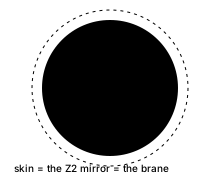
The stage: a 4-ball with a 3-sphere skin
A 4-dimensional ball whose 3-sphere skin is the Z2 mirror — the brane. Nothing lies beyond it: the dashed "outside" is our own bulk in reflection. Everything we call cosmology happens on and in that skin.
The engine
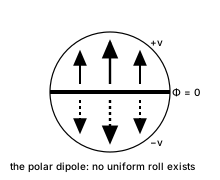
The engine forms — it is never inserted
The Z2-odd Higgs has no uniform mode, so the hilltop is left by a polar dipole: our half rolls to +v, the mirror-image half rolls to −v, pinned to zero on the equator. The collapse at the pole — the centre of our ball — is the engine: the non-linear endpoint of that instability, formed by the field dynamics, never hand-inserted.
The kink wall & the mirror boundary
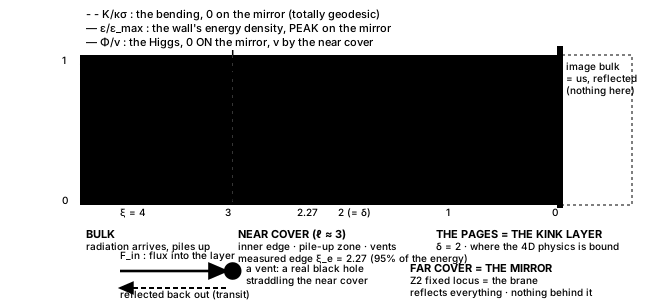
The layer, measured: three profiles across the wall
Reading right to left, the way the bulk sees it: the Higgs field Φ (green) climbs from zero on the mirror to its vacuum value by the near cover; the wall's energy density ε (amber) peaks exactly on the mirror; the bending K (blue, dashed) is zero on the mirror — totally geodesic — and rises to the thin-wall value only at the near cover. The measured edge of the layer sits at ξ_e = 2.27, against a tanh scale δ = 2.
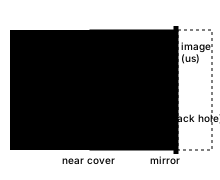
The wall is a layer, not a surface
Bulk → near cover (the pile-up zone, where vents form) → the pages (the Higgs kink, thickness δ = 2 in code units) → far cover = the mirror (the Z2 fixed locus; totally geodesic; reflects everything; nothing behind it). Resolved, not expanded — its gravitational thickness κσδ ≈ 1.4 rules out a thin-wall treatment.
Birth & injection
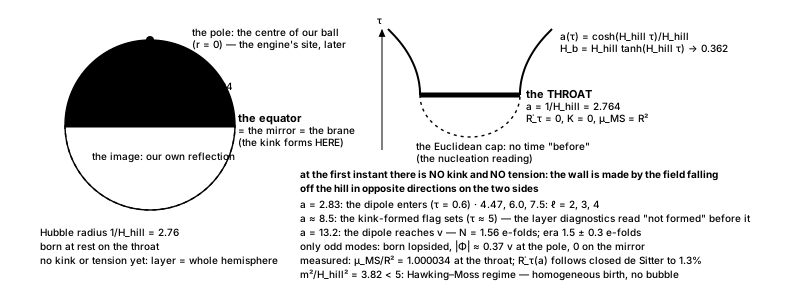
The throat: born at rest, then accelerating
Read as a nucleation, the universe begins on de Sitter's minimal-radius slice — the throat — at radius a = 1/H_hill, born at rest (zero expansion rate, zero extrinsic curvature), then accelerating outward. Fluctuation modes enter one by one as the ball grows: the dipole first, then higher shells. At the first instant there is no kink and no tension — the wall is made by the field falling off the hilltop in opposite directions on the two sides.
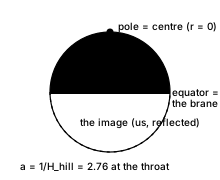
The birth: a small, closed hilltop universe
The hilltop's own energy gravitates, so the newborn universe is a small closed ball — Hubble radius 1/H_hill ≈ 2.76 in code units — with the brane on its equator, our bulk one hemisphere and the mirror image the other.
Vents & the brane's Big Bang
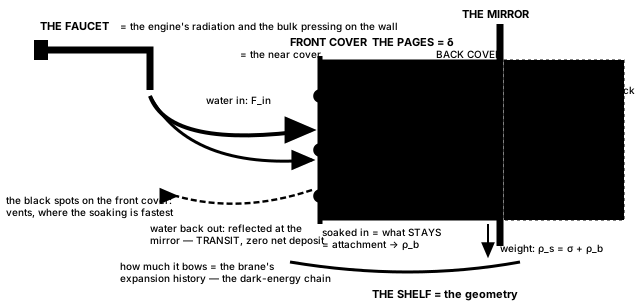
The hydraulic jump, illustrated
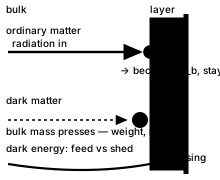
A partial analogy, read precisely: the brane is a standing front where incoming energy piles up and part of it dissipates — but it is a smooth, resolved domain wall, not a shock or a horizon. Radiation from the bulk (the faucet) mostly reflects back out at the mirror (transit); what soaks in and stays is the brane's own matter density, and its weight curves the shelf — the brane's expansion history.
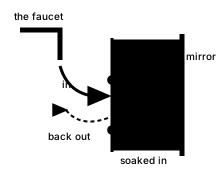
Transit, not absorption
Radiation transits the layer and reflects at the mirror — zero net deposit over a round trip. What converts or gets trapped inside stays, and the paper gets heavier. Three channels do it: the gauge-boson mass well at the core, the entropy/conversion channels, and trapping in a vent.
Venting is attachment, not transmission
A vent is a real black hole (a trapped surface) that forms in the pile-up zone. Radiation it captures is remade there as brane matter and soaks into the brane's own energy density — nothing leaves through the mirror. Bulk mass pressing on the layer from outside is felt as weight with no matching light (a dark-matter candidate, bulk-side); dark energy is the running balance of what the engine feeds the wall against what the wall sheds.
The Λ / dark-energy chain
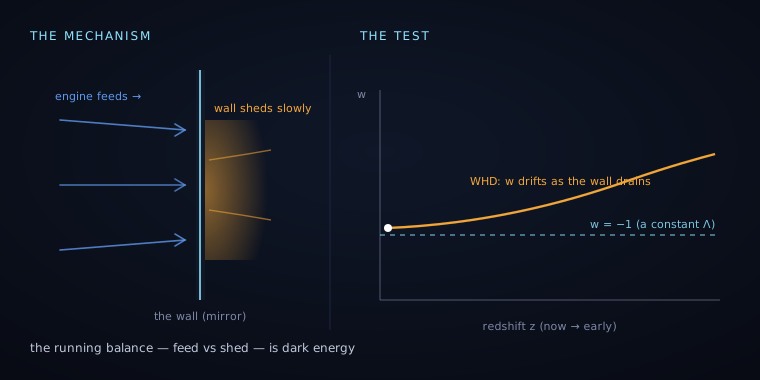
The Λ / dark-energy chain: the wall's slow drain
How the wall's slow shedding of energy behaves like dark energy — the balance between what the engine drives outward and what the wall lets through, and the expansion-history test that could confirm or break it.
The UV candidate
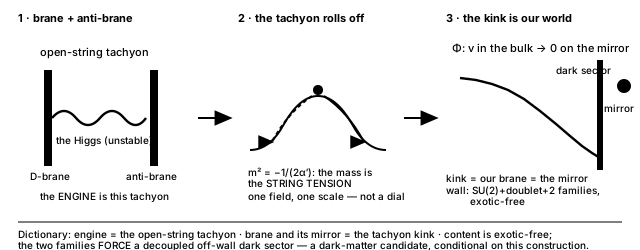
A guess at the weave: brane–antibrane to tachyon to kink
A candidate string origin for the program — a reasoned guess, pursued because it would explain where the constants come from. An open-string tachyon strung between a brane and its anti-brane is the Higgs, and it is the engine; where it rolls off its hilltop it forms a kink that vanishes on the mirror — and that kink is our brane. Two chiral families force a decoupled, off-wall dark sector to exist.