The Thick-Wall Kink Brane and the Z2 Mirror Boundary
DraftingDeriving the brane as a resolved domain wall, not an assumed thin membrane
preprint — not yet on arXiv gr-qc updated 2026-09-09
Abstract. We construct the brane — our 3+1D universe — as the fixed locus of a Z2 (reflection × SU(2)-center) identification of a doubled 4+1D bulk, rather than positing it as an infinitely thin membrane with hand-chosen junction conditions. Under this identification, every field's boundary behavior (Dirichlet for odd fields, Neumann for even fields, vanishing flux for all) is a theorem of the symmetry, not a modeling choice. The Higgs-like field is odd under the identification and has no spatially-uniform mode on a closed slice; the only way it can roll off its unstable symmetric point while respecting the identification is a domain-wall (kink) profile pinned to zero on the mirror itself — so the brane is the *endpoint of an instability*, never an inserted object. We show the resulting layer is numerically resolved, not thin-wall expanded (gravitational thickness κσδ ≈ 1.4, an O(1) number with no small parameter to expand in), derive the layer's emergent tension and attached matter density as integrals over the resolved profile rather than inputs, and show the construction admits no image-wall collision: the mirror is totally geodesic and reflects every field without exception.
The typeset PDF is not posted yet.
The plain-English version and the figures are ready now — use the tabs above. The paper itself goes up here once it is ready to circulate.
The question this paper answers
Most brane-world models start by assuming a thin membrane sits somewhere in a higher-dimensional bulk, then write down junction conditions — rules for how the geometry bends across that membrane — as a modeling choice. This paper asks a more basic question: can the brane, and its boundary conditions, be derived instead of assumed? The answer here is yes, and the mechanism is a mirror.
The mirror is not a wall we build — it’s a symmetry we impose
Picture our whole bulk, then imagine a second, identical copy of it, glued to the first along a shared boundary, but with one field flipped in sign (specifically: reflect the extra spatial direction, and simultaneously flip the center of the gauge group). Demanding that this doubled construction actually be symmetric under that flip is the Z2 identification. Once you demand that symmetry, every field’s behavior at the shared boundary stops being a choice: a field that’s even under the flip must have zero slope there (it’s looking at its own mirror image and matching smoothly); a field that’s odd must vanish there outright (its mirror image is its negative, and the only value equal to its own negative is zero). Nothing crosses the boundary — the “other side” is not a separate place, it’s our own reflection.
Why this makes a wall, not just a boundary
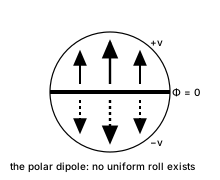
The Higgs-like field in this program is odd under the identification. On a closed, connected slice, an odd field literally cannot sit at any single uniform value everywhere — the only way to be both odd and uniform is to sit at exactly zero, which happens to be the least stable point of its energy landscape (the top of a “Mexican hat,” an unstable local maximum). So when this field is disturbed off that unstable point, it can’t roll off uniformly — it’s forced to roll one way on our side and the mirror-opposite way on the other side, crossing exactly zero in between. That forced, two-sided roll traces out a domain wall, a “kink” in field-theory language — and that kink is the brane. It isn’t inserted into the model; it’s the shape the field is mathematically compelled into by the symmetry plus the instability.
Thick, not thin — and why that matters
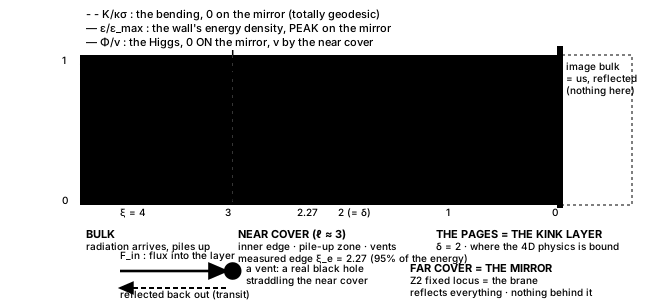
A lot of brane-world physics assumes the wall is infinitely thin compared to everything else, which lets you treat it as a mathematical surface with a jump condition across it. This paper measures the actual gravitational thickness of the resolved kink, — roughly “the wall’s self-gravity relative to its tension, times its width” — and finds it’s of order 1, not small. That means there is no honest thin-wall expansion available: the wall has to be numerically resolved, layer by layer, not approximated as a sharp cut. Read from the bulk inward, the layer has three parts: a near cover (where incoming radiation first piles up, and where localized black holes — “vents” — can form), the pages (the Higgs kink itself, where our familiar 4D physics is confined), and a far cover, which is the mirror itself — perfectly reflecting, bending nothing (it is what a geometer would call totally geodesic), with nothing behind it.
What used to be inputs are now measurements
In the older, thin-wall picture, quantities like the wall’s tension and its rate of motion were things you typed in as parameters. Once the layer is resolved, they become things the simulation measures: the tension is now an integral of the kink’s energy across its thickness, and the “junction condition” that used to be an assumed input becomes a consistency check the resolved layer either passes or fails as it approaches the thin limit. This paper reports both the formalism for that measurement and the specific checks (gates) a resolved run must pass before its output can be called a validated brane.
No image-wall collision
A natural worry about a “doubled bulk with a mirror” picture is whether the wall and its own mirror image can collide — whether the construction secretly requires two separate walls that might crash into each other. They can’t, by construction: the mirror is a single fixed locus, totally geodesic, and the kink sits on it, not near it. There is only ever one wall, seeing its own reflection.
If you want the exact derivation — the parity table field by field, the Israel-residual measurement, the resolution requirement in physical units — the PDF is the authoritative version; this page is a faithful restatement, not a substitute.
The engine forms — it is never inserted
The Z2-odd Higgs has no uniform mode, so the hilltop is left by a polar dipole: our half rolls to +v, the mirror-image half rolls to −v, pinned to zero on the equator. The collapse at the pole — the centre of our ball — is the engine: the non-linear endpoint of that instability, formed by the field dynamics, never hand-inserted.
The layer, measured: three profiles across the wall
Reading right to left, the way the bulk sees it: the Higgs field Φ (green) climbs from zero on the mirror to its vacuum value by the near cover; the wall's energy density ε (amber) peaks exactly on the mirror; the bending K (blue, dashed) is zero on the mirror — totally geodesic — and rises to the thin-wall value only at the near cover. The measured edge of the layer sits at ξ_e = 2.27, against a tanh scale δ = 2.
The wall is a layer, not a surface
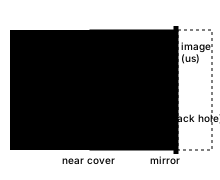
Bulk → near cover (the pile-up zone, where vents form) → the pages (the Higgs kink, thickness δ = 2 in code units) → far cover = the mirror (the Z2 fixed locus; totally geodesic; reflects everything; nothing behind it). Resolved, not expanded — its gravitational thickness κσδ ≈ 1.4 rules out a thin-wall treatment.