A UV Completion Candidate: WHD as a Brane–Antibrane String Vacuum
DraftingA realizable point in the string landscape — its selection remains conjecture
preprint — not yet on arXiv hep-th (cross-list: gr-qc) updated 2026-09-10
Abstract. A candidate ultraviolet completion of WHD: its low-energy constants and matter content read as correlated fingerprints of a single non-supersymmetric, strongly-coupled charged brane–antibrane string vacuum (Type IIA on T⁵/Z2, an O4₊ orientifold, a magnetized D6 giving SU(2)). The Higgs is the open-string tachyon, so its mass is forced — m² = −1/2α′ — not chosen; the tachyon kink is our brane; and the Z2 mirror that defines the brane is shown to be an exact string orbifold: the residual K-theory class evaluates to zero, three independent ways. A dark sector is forced (the induced charge equals the family number, two), with a dynamically-selected net charge and a falsifiable dark-radiation ceiling (ΔN_eff ≲ 0.02, below CMB-S4 reach). The vacuum sits at genuine strong coupling with no weak-coupling corner, which caps the claim that it is the selected vacuum at grade M, irreducibly. Realizable is not selected — this is a consistency proof of a candidate, not a derivation of reality, and it is load-bearing for nothing: every required gate in the WHD program stands whether or not any part of this survives future scrutiny.
Read this first. This paper makes two claims that are easy to
conflate, and they are not the same one. Realizability — that
WHD’s low-energy physics sits at a genuine, consistent point in the string
landscape — is shown, within the framework, three independent ways:
the Higgs is forced to be the open-string tachyon (its mass fixed, m² = −1/2α′),
the tachyon kink is the brane, and the Z2 mirror that defines it is an
exact string orbifold whose residual K-theory class evaluates to
zero, with consistent tadpoles across the whole RR-flux family. That is what
“a place in the landscape” means here — a construction that exists and is
consistent, proven-exact in-framework [C].
Selection is the question of whether this is the address the
landscape actually chooses — dynamical or measure-theoretic selection,
which the string construction does not settle. It is genuinely open. The vacuum
sits at genuine strong coupling with no weak-coupling corner, a physical fact
that caps the selection claim at [M], irreducibly. Realizable is
not selected. And none of it is load-bearing: every required
numerical gate elsewhere in this series stands whether or not a sentence here
survives future scrutiny. Marks — [C] proven within the framework,
[F] a forced fingerprint, [M] motivated but not
demonstrated, [W] weak/unquantified.
The question this paper asks
Everywhere else in this series, four numbers — a mass parameter, a self-coupling, a gauge coupling, a cutoff scale — are simply declared: chosen for naturalness and unit convenience, the way any effective field theory declares its inputs. This paper asks the next question down: could those four numbers be outputs of something, instead of choices?
The one idea: the Higgs is the tachyon
The candidate answer is that WHD is a specific kind of string vacuum: a
brane sitting next to its own anti-brane, which are pulled together by
their mutual attraction. Stretched between them is an open-string field
that is unstable — a “tachyon” in the technical sense, meaning it sits
at an unstable maximum of its own energy, exactly like a pencil balanced
on its tip. The candidate’s central claim [F] is that this
tachyon is the same field this whole program calls the Higgs — one
field, one scale, appearing twice under two different names depending on
which part of the story you’re looking at. If that identification holds,
the field’s mass isn’t a free dial at all: it’s fixed by the string
tension itself (m² = −1/2α′), the sharpest, most falsifiable piece of the
whole candidate.
Why the brane doesn’t just annihilate to nothing
A brane and an anti-brane, left alone, generically annihilate completely —
that’s the textbook outcome, and it’s the obvious objection to this whole
idea: why is there a universe left over, rather than empty string vacuum?
The resolution [C] turns on the same mirror
symmetry the rest of this program relies on: the tachyon is forced to be
odd under the identification, and an odd field cannot sit at any single
uniform value except zero — the least stable point there is. The only way
to be both odd and rolling downhill is a two-sided roll, our side one way
and the mirror side the opposite way, crossing zero in between. That
forced, lopsided roll is a kink, not a uniform collapse — and a kink does
not have “annihilate to nothing” available to it. And this mirror is not a
low-energy assumption bolted on to make that work: it is an exact string
orbifold. The one thing that could have spoiled it — a leftover charge
threading the extra dimensions — collapses to a single yes-or-no class, and
that class evaluates to zero, shown three independent ways. So the
annihilation mode is removed by the construction itself [C].
That makes WHD a demonstrated consistent place in the string landscape —
realizable, whether or not it is the vacuum nature selects.
A forced dark sector
The construction is required to satisfy a strict bookkeeping rule (charges
threading the compact extra dimensions must cancel). Satisfying the
leading version of that rule [C] is exactly what forces a
specific structural fact: an even, minimum-of-two count of chiral matter
families (forbidding an odd count is a clean consequence of an anomaly in
the gauge group, not a choice), and — the genuine payoff — that same
family count forces a decoupled, off-wall dark sector to exist. Dark
matter here is a structural consequence of the number of matter families
we already observe.
The one sharp, near-term test
This dark sector is not a weak-scale WIMP, and underground detectors built
to find one [C] cannot test it — there’s no light portal
particle, only gravity and string-suppressed couplings, both far below
current direct-detection sensitivity. The one real, quantitative,
near-term handle [C for existence and sign; M for size] is
dark radiation: because this program’s vents (real black holes that
make our ordinary matter) are brane-directed, any leak into the hidden
sector heats it less than it heats us — a small, positive excess in the
effective number of relativistic species (ΔN_eff), never the large
“democratic” value a symmetric leak would give (which is already
excluded). Upcoming CMB surveys are precise enough to catch this or rule
it out.
What this candidate does not claim
It does not claim to be the completion, or the one nature necessarily
selects — realizable is not the same as selected. It does not claim the
construction is fully checked (a deeper bookkeeping condition tied to the
string coupling itself does not cancel by the usual static argument, and
the proposed dynamical resolution sits in a regime where the
approximations that would verify it are least trustworthy [C, for
the gap; M, for the proposed resolution]). And it explicitly
withdraws an earlier, over-stated claim that a safe outcome is generic
[W]: the physics plausibly favors the dangerous configuration
at least as much as the safe one.
If you want the full derivation — the exact fingerprint formulas, the tadpole and dilaton bookkeeping, the ΔN_eff calculation — the PDF is the authoritative version, once it exists; this page is a faithful restatement, not a substitute, and it is exactly as conditional as the work it restates.
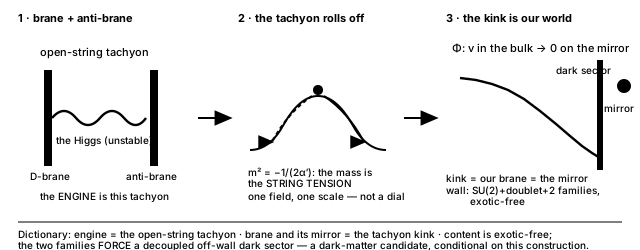
A guess at the weave: brane–antibrane to tachyon to kink
A candidate string origin for the program — a reasoned guess, pursued because it would explain where the constants come from. An open-string tachyon strung between a brane and its anti-brane is the Higgs, and it is the engine; where it rolls off its hilltop it forms a kink that vanishes on the mirror — and that kink is our brane. Two chiral families force a decoupled, off-wall dark sector to exist.